
Feasibility Study
Introduction
Have you ever thought about starting a business or project, but felt unsure whether it will actually work in real life? Many people get excited about ideas, but later they face loss because they did not check the reality first. This is where a Feasibility Study becomes very important. It is a smart and simple process that helps you understand whether your idea is practical, profitable, and safe before you invest money and time.
A feasibility study works like a reality check. It tells you clearly if your idea can survive in the real market or not. Instead of guessing, you use real data, research, and simple analysis to make a strong decision. This process saves you from mistakes and helps you move in the right direction with confidence.
What is Feasibility Study?
A Feasibility Study means checking whether a business idea or project is possible to complete successfully or not. It is a detailed study that looks at different important areas such as market demand, cost, technical ability, and risk factors. The main goal is to understand if the project should be started or not.
In simple words, it is like testing your idea before launching it. You try to find answers to questions like: Will people buy my product? Can I afford the cost? Do I have enough skills and resources? If the answers are mostly positive, then your idea is considered feasible and worth starting.
Importance of Feasibility Study
A feasibility study is very important because it protects you from wrong decisions. Many people lose money in business because they skip this step and directly jump into action. When you do proper research, you can clearly see whether your idea has real potential or not.
It also helps you make better planning. Instead of working blindly, you get a clear roadmap of what to do, how to do it, and when to do it. This makes your project more organized and structured. Another big benefit is risk reduction. Every business has risk, but a feasibility study helps you identify those risks early so you can prepare for them properly.
It is also very useful for getting investment. If you want money from a bank or investor, a strong feasibility report increases trust and shows that your idea is well planned and safe.
Types of Feasibility Study
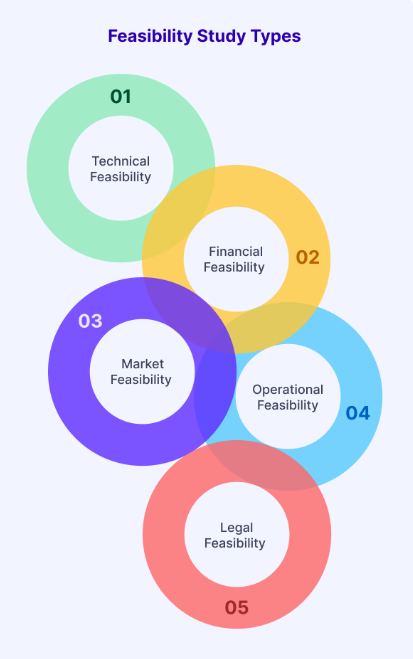
A feasibility study is divided into different types, and each type focuses on a specific area of analysis. One of the most important types is technical feasibility, which checks whether you have the technology, tools, and skills to complete the project successfully. For example, if you want to build a website or app, you must have developers and technical support.
Another important type is economic feasibility, which focuses on cost and profit. It checks how much money you need to start the project and how much profit you can expect. This helps you understand whether the project is financially worth it or not.
Market feasibility is also very important because it studies customer demand and competition. It helps you understand if people actually want your product and how strong your competitors are in the market.
There is also operational feasibility, which checks whether your business can run smoothly on a daily basis. It looks at your team, management system, and working process. Lastly, legal feasibility ensures that your project follows all laws, rules, and government regulations so that you do not face legal problems later.
Key Components of Feasibility Study
A complete feasibility study includes several important parts that work together to give a full picture of your project. The first part is the project overview, where you clearly explain your idea, goals, and purpose in simple words. This helps everyone understand what you are trying to do.
The second part is market research, which is one of the most powerful sections. Here you study your customers, their needs, buying behavior, and competition. This helps you understand if there is real demand in the market.
The third part is financial analysis, where you calculate all costs and expected income. You check if your project can make profit after covering all expenses. The fourth part is risk analysis, where you identify possible problems and find solutions before starting the project.
Process of Feasibility Study
The process of doing a feasibility study starts with clearly defining your idea. You must know exactly what you want to do and what problem you are solving. After that, you move to market research, where you collect information about customers, demand, and competitors.
Next, you analyze technical requirements to check if your project is possible with available resources and technology. Then you calculate financial cost and expected profit, which helps you understand whether the project is financially strong or weak.
After that, you identify risks and challenges that may come in the future. Finally, you combine all findings and make a final decision whether to start the project or not.
Real-Life Example
Let’s take a simple example. Imagine you want to open a small coffee shop near a college. First, you check if there are enough students in that area who can become your customers. Then you study other coffee shops nearby to understand competition.
After that, you calculate your rent, equipment cost, and daily expenses. You also estimate how much you can earn daily. If everything looks positive, then you can confidently start your coffee shop. This is how a feasibility study works in real life.
Common Mistakes to Avoid
Many people fail because they make simple mistakes during their feasibility study. One common mistake is ignoring market demand. Even if your idea is good, it will fail if no one wants it. Another mistake is underestimating cost, which leads to financial problems later.
Some people also ignore competitors, which is very dangerous because competitors can strongly affect your business. Another big mistake is relying on guesswork instead of real data. A good feasibility study must always be based on facts, not assumptions.
Practical Tips for Success
If you want your feasibility study to be strong, always start small instead of investing a large amount of money at once. This helps you test your idea safely. Always focus on customer needs because customers are the real foundation of any business.
You should also collect real data through surveys, feedback, and research instead of guessing. Talking to experienced people can also give you valuable insights. Most importantly, always have a backup plan in case your first idea does not work as expected.
Advanced Feasibility Study Process (Deep Understanding)
Now let’s go deeper into how a Feasibility Study actually works in real business life. In the real world, it is not only about basic checking. It is a step-by-step thinking process where you slowly build confidence about your idea using facts, numbers, and real market signals. Many successful businesses do not start directly. They first study everything carefully, and only then they invest money.
The first advanced step is data collection. This means you do not depend on guessing. You collect real information from customers, market reports, competitors, and surveys. For example, if you want to open a shop, you should go and see how many people are buying similar products in that area. This real observation is very powerful because it shows the true demand, not imagination.
The second step is data analysis. After collecting information, you need to understand what it means. You compare numbers, study patterns, and find out whether the market is strong or weak. This is where you decide if your idea has real potential or not. Without proper analysis, data is useless. This step helps you turn raw information into smart decisions.
The third step is feasibility comparison, where you compare your idea with existing competitors. You check what others are doing, how they are pricing, and what mistakes they are making. This helps you design a better strategy. Many new businesses fail because they ignore this step and repeat the same mistakes as others.
The fourth step is final evaluation, where you combine everything—market, cost, risk, and technical ability—and make a final judgment. This is the most important stage because here you decide whether to move forward or stop the project. A good feasibility report always ends with a clear decision, not confusion.
Real Business Strategy Behind Feasibility Study
In real business, a feasibility study is not just a document. It is a thinking strategy. Big companies use it before launching new products. Even small businesses use it before investing money. The main goal is always the same: reduce risk and increase success chances.
One strong strategy is pilot testing. This means you start on a small scale before going big. For example, if you want to sell food, you can start with a small stall before opening a full restaurant. This helps you understand real customer response without taking big risk.
Another strategy is customer validation. Instead of assuming what people want, you ask them directly. You can talk, survey, or observe their behavior. This gives you real insights about demand. Many businesses fail because they build products nobody actually wants. A good market feasibility study prevents this mistake.
You also need financial planning strategy, where you prepare a clear budget. You calculate how much money you need, how long it will last, and when you expect profit. If your financial plan is weak, your business will struggle even if your idea is good. Money management is a core part of feasibility success.
Mistakes People Make in Feasibility Study
Many beginners think feasibility study is easy, but they make serious mistakes that lead to failure. One common mistake is emotional decision-making. People fall in love with their idea and ignore real data. This is very dangerous because business does not run on emotions; it runs on demand and profit.
Another mistake is over-optimism. Some people believe everything will go perfectly. They ignore risks, competitors, and market problems. But in real life, nothing is perfect. A strong risk analysis always includes worst-case scenarios so you can prepare properly.
A third mistake is ignoring small costs. People often calculate only big expenses like rent or product cost, but they forget small things like transport, maintenance, marketing, and utilities. These small costs slowly increase and affect profit.
Another big mistake is skipping competitor study. If you do not understand your competitors, you cannot survive in the market. Competitors already have customers and experience. Without studying them, your strategy becomes weak.
Practical Tips to Make Feasibility Study Strong
If you want your feasibility analysis to be powerful, always focus on real-world data. Do not depend on theory or assumptions. Go outside, talk to people, and observe the market directly. Real experience is always better than guessing.
Always break your idea into small parts. Instead of thinking everything at once, divide it into market, cost, operation, and risk. This makes your study easy and clear. When things are simple, decisions become better.
Use simple tools like Excel or paper notes to track your data. You do not need complex systems in the beginning. What matters is accuracy, not complexity. A simple but correct feasibility report is better than a fancy but wrong one.
Also, always keep updating your study. Market conditions change. Customer behavior changes. Prices change. So your feasibility study should also be flexible and updated regularly. This keeps your business plan strong and relevant.
Why Feasibility Study is a Long-Term Success Tool
A Feasibility Study is not only for starting a business. It is also useful for long-term success. Even after starting a business, you can use feasibility thinking to expand, improve, or change direction.
It helps you make smart decisions like:
- Should I expand my business?
- Should I change my product?
- Should I enter a new market?
Every big decision becomes easier when you use feasibility logic. It keeps your business stable and reduces emotional mistakes.
Final Bottom Line
A strong Feasibility Study is like a safety shield for your business idea. It protects you from loss, guides your planning, and increases your chance of success. It teaches you to think before acting, and to use facts instead of emotions.
Related Posts