Earth or Sand Filling Volume Calculation
- masum
- May 2, 2026
- Uncategorized
Introduction
Have you ever seen a piece of land that is lower than the road or uneven and thought, “How much soil or sand is needed to make it level?” This is a very important question in construction work. If you guess wrong, you may waste money or face shortage of material during work.
In real projects like house building, road construction, land development, or factory site preparation, proper filling is the first step. This work is called Earth or Sand Filling, and measuring its amount is called Earth or Sand Filling Volume Calculation.
Without correct calculation, the ground may settle later, floors may crack, or water may not drain properly. That is why engineers always calculate the exact volume before starting work.
In simple words, this calculation tells us how much soil fill or sand fill is needed to raise the land to the required level.
What is Earth or Sand Filling Volume Calculation?
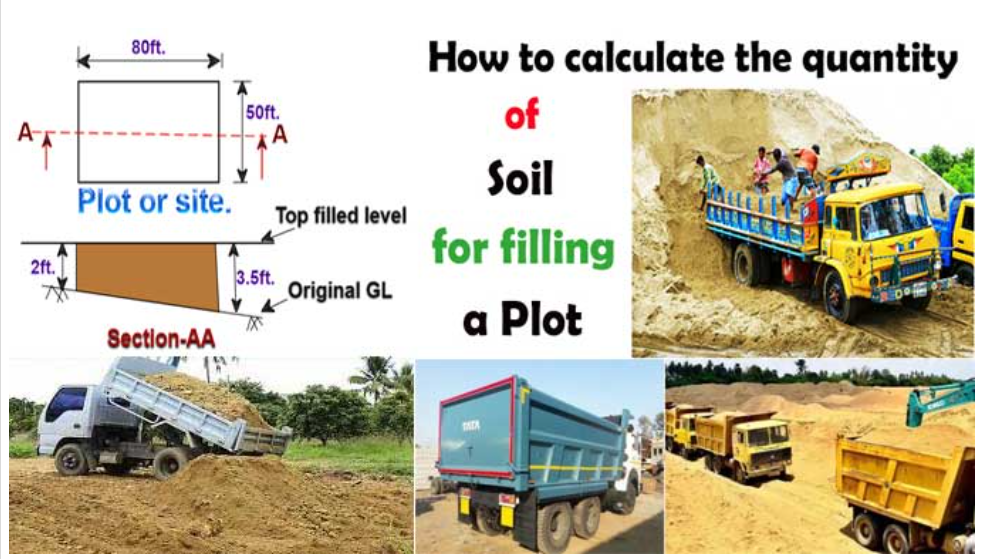
Earth or Sand Filling Volume Calculation is the process of measuring the total volume of filling material required to raise ground level. The material can be soil fill, sand fill, compacted earth, river sand, or selected filling materials based on project need.
The main goal is simple:
Calculate the empty volume that needs filling.
Then convert that volume into actual material quantity.
This helps in construction planning, site preparation, land leveling, and budget estimation.
For example, if your land is low by 2 feet, you need to know exactly how much filling material is required to raise it by that height. Earth or Sand Filling Volume Calculation Without calculation, you may order too little or too much.
Why Filling Volume Calculation is Important
Many people think filling is simple. They believe trucks can bring soil until the area becomes level. But in reality, wrong estimation creates many problems.
Here is why proper calculation matters:
1) Helps Estimate Material Quantity
You know exactly how much earth fill or sand fill is required.
This avoids shortage during work.
It also prevents over-ordering.
2) Saves Construction Cost
Extra filling means extra money.
Wrong calculation increases transport cost, labor cost, and material waste.
Accurate calculation saves budget.
3) Better Site Planning
You can plan truck trips, unloading space, and work schedule properly.
This makes construction smooth.
4) Improves Foundation Quality
Correct filling creates better ground compaction.
Strong compaction gives strong foundation support.
This increases building safety.
5) Prevents Water Problems
Good filling creates proper slope.
This helps rainwater drainage.
Poor filling causes waterlogging.
Basic Formula for Filling Volume Calculation
The simplest formula is:
Volume=Length×Width×HeightVolume = Length \times Width \times HeightVolume=Length×Width×Height
Here:
Length = total length of land
Width = total width of land
Height = filling depth or height difference
Result = filling volume
You can calculate in:
- Cubic Feet
- Cubic Meter
- Cubic Yard
These are common volume measurement units in construction.
1: Simple Sand Filling Calculation
Suppose:
Length = 50 feet
Width = 30 feet
Fill height = 2 feet
Calculation:
Volume = 50 × 30 × 2
Volume = 3000 cubic feet
That means:
You need 3000 CFT sand for filling.
Simple and easy.
2: Calculation in Cubic Meter
Suppose:
Length = 20 meter
Width = 10 meter
Height = 1 meter
Calculation:
Volume = 20 × 10 × 1
Volume = 200 cubic meter
So you need:
200 m³ filling material
This method is common in engineering projects.
Types of Filling Materials
Different projects use different materials.
Earth Filling
This uses normal soil.
It is cheap.
Best for land raising.
Sand Filling
Uses clean sand.
Good for foundation preparation.
Provides better drainage.
Selected Fill Material
Engineered filling soil.
Used in important construction work.
Higher strength.
Clay Filling
Used in some special areas.
Good binding quality.
Poor drainage.
Important LSI Keywords for Filling Calculation
You should know these related terms:
- Land filling calculation
- Soil volume estimation
- Sand quantity calculation
- Construction fill material
- Compaction factor
- Excavation and filling
- Site leveling measurement
- Earthwork quantity survey
- Volume estimation in construction
- Fill material cost estimation
These keywords are commonly used in civil engineering and land development.
Measuring the Site Correctly
Calculation starts with proper measurement.
1: Measure Length
Take full length measurement.
Use tape or survey equipment.
2: Measure Width
Measure full width carefully.
Record exact numbers.
3: Measure Height Difference
Find low level and target level.
Difference = fill height.
4: Multiply Values
Use formula.
Get total volume.
This gives raw volume estimate.
Practical Tip
Always add 10% to 20% extra material.
Why?
Because filling material settles after compaction.
Loose soil becomes compact.
Actual height reduces.
So extra filling is needed.
Example:
Required = 3000 CFT
Add 15%
Extra = 450 CFT
Total = 3450 CFT
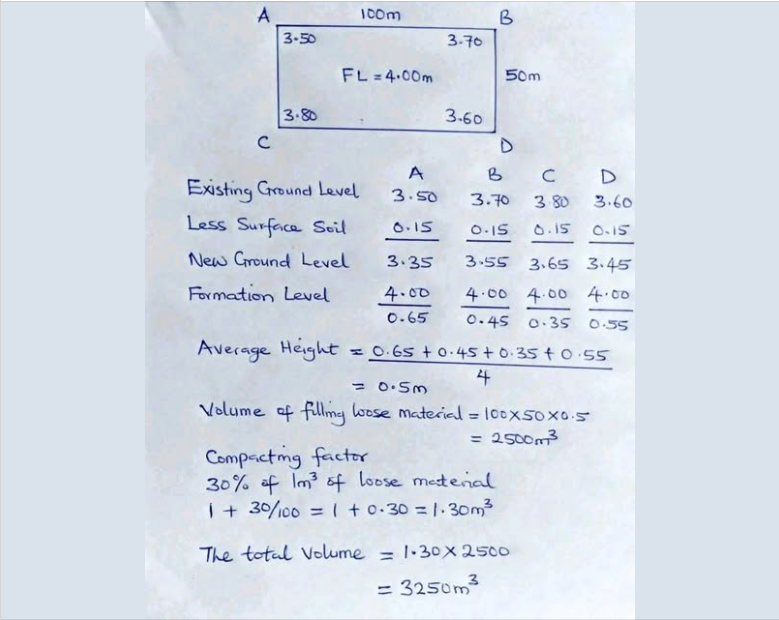
Compaction Factor in Earth or Sand Filling
Have you ever noticed something strange in construction work? A truck brings a large amount of soil or sand, workers spread it on the ground, and after rolling or compacting, the height becomes lower. Why does this happen?
This happens because of compaction.
Compaction means pressing loose soil or sand tightly so empty air gaps inside the material become smaller. Earth or Sand Filling Volume Calculation When those gaps reduce, the material becomes dense, strong, and stable. This is very important for foundation work, road construction, land development, and site preparation.
Without proper compaction, the ground may settle later. This can create cracks in floors, weak foundations, uneven roads, and drainage problems. That is why engineers always consider Compaction Factor while calculating earth filling volume or sand filling quantity.
What is Compaction Factor?
Compaction Factor means the difference between loose material volume and compacted material volume.
Loose soil takes more space.
Compacted soil takes less space.
This means you need extra filling material.
For example:
If compacted requirement = 1000 CFT
Extra needed = 15%
Total loose fill required = 1150 CFT
This extra amount covers settlement after rolling and compaction. Earth or Sand Filling Volume Calculation
Common Compaction Allowance
Usually:
- Sand filling = add 10%–15%
- Earth filling = add 15%–25%
- Clay soil filling = add 20%–30%
This depends on soil type, moisture, and compaction method.
Pro Tip
Never order exact calculated volume.
Always include compaction allowance.
This saves time and prevents material shortage.
Truck Load Calculation for Filling Material
In real projects, materials come by truck.
So after volume calculation, the next question is:
How many truckloads are needed?
This is very important for cost estimation, transport planning, and construction scheduling.
Formula
Number of Trucks=Total VolumeTruck CapacityNumber\ of\ Trucks = \frac{Total\ Volume}{Truck\ Capacity}Number of Trucks=Truck CapacityTotal Volume
Example
Suppose total required filling:
= 5000 CFT
Truck capacity:
= 250 CFT
Calculation:
Truck needed = 5000 ÷ 250
Truck needed = 20 trucks
Very simple.
Why Truck Calculation Matters
It helps in:
- transport budget planning
- unloading planning
- labor scheduling
- site access management
- project timeline control
Large projects depend heavily on this estimation.
Cost Estimation for Earth or Sand Filling
Correct volume calculation helps estimate project cost.
Cost depends on:
- material price
- truck transport charge
- unloading labor
- spreading cost
- water compaction cost
- roller compaction cost
- site leveling cost
Basic Formula
Total Cost=Volume×RateTotal\ Cost = Volume \times RateTotal Cost=Volume×Rate
Example
Required sand:
= 3000 CFT
Rate:
= 60 টাকা per CFT
Calculation:
Total cost = 3000 × 60
Total = 180,000 টাকা
Then add:
- labor cost
- transport cost
- equipment charge
Final cost becomes full project estimate.
How Engineers Measure Uneven Land
Most land is not flat.
Some areas are high.
Some areas are low.
Simple Length × Width × Height may not give correct result.
Engineers use better methods. Earth or Sand Filling Volume Calculation.
Grid Method
Land is divided into small squares.
Each square height is measured.
Then average depth is calculated.
This gives accurate result.
This is common in site leveling survey, earthwork quantity survey, and construction planning.
Cross Section Method
Land is divided into sections.
Each section volume is measured.
Then total volume is added.
Used in:
- road work
- canal work
- embankment filling
- large land development
Very useful for civil engineering projects.
Moisture Content Matters
Dry soil and wet soil behave differently.
Wet soil becomes heavy.
Dry sand becomes loose.
Moisture changes compaction quality.
Good moisture level gives better density.
That creates stronger fill base.
This is called optimum moisture content in engineering. Earth or Sand Filling Volume Calculation
Best Tips for Accurate Filling Calculation
Measure many points
Do not measure one point only.
Take multiple readings.
Check ground level
Use survey tools.
Level difference matters.
Add compaction factor
Always include settlement.
Check truck capacity
Not all trucks carry same volume.
Use proper material
Bad soil creates weak fill.
Compact layer by layer
Do not dump thick loose fill.
Thin layers compact better.
Common Mistakes to Avoid
Many people make simple mistakes:
- wrong site measurement
- ignoring compaction
- ordering exact quantity
- using poor soil
- poor leveling
- no drainage planning
- wrong truck capacity assumption
Advanced Calculation Methods
Basic formula works for flat land, but real sites are often uneven. So engineers use better methods.
1) Average Depth Method
If land is uneven, take several depth points.
Then find average depth.
Average Depth=Sum of all depthNumber of pointsAverage\ Depth = \frac{Sum\ of\ all\ depth}{Number\ of\ points}Average Depth=Number of pointsSum of all depth
Then:
Volume = Length × Width × Average Depth
This method is simple and widely used.
2) Grid Method (Better Accuracy)
Land is divided into small squares.
Each square height is measured.
Then all volumes are added.
This gives very accurate earthwork quantity estimation.
Used in:
- road projects
- large land filling
- housing projects
Real Site Example (Easy Understanding)
Suppose a plot is:
- Length = 40 ft
- Width = 25 ft
- Average depth = 1.5 ft
Volume:
Volume=40×25×1.5Volume = 40 \times 25 \times 1.5Volume=40×25×1.5
= 1500 CFT
Now add 15% compaction:
Total = 1725 CFT
So you need about 1725 CFT sand/earth.
Filling Quality Check (Very Important)
Good filling is not only about quantity. Quality also matters.
Check points:
- Soil must be clean (no waste)
- No big stones or garbage
- Proper moisture level
- Layer by layer compaction
- No loose soft spots
Bad quality fill can damage building foundation later.
Environmental Factors
Some natural factors also affect filling: Earth or Sand Filling Volume Calculation.
1) Rain
Rain makes soil soft and heavy.
2) Water Drainage
Poor drainage causes sinking later.
3) Soil Type
Clay, sand, or mixed soil behaves differently. Earth or Sand Filling Volume Calculation
4) Groundwater Level
High water level can reduce stability.
Always consider these before filling.
Bottom Line / Review
Earth or Sand Filling Volume Calculation is very important for any construction work. It helps you know exact material quantity, cost, and planning.
Simple formula works for basic sites, but real projects need compaction factor and proper measurement. Earth or Sand Filling Volume Calculation
If you calculate correctly, you can:
- save money
- avoid material waste
- improve land strength
- make strong foundation
Related Posts